Pythagoras Post

Thursday, February 26, 2009


Made By: Deb Russell

The Pythagorean theorem

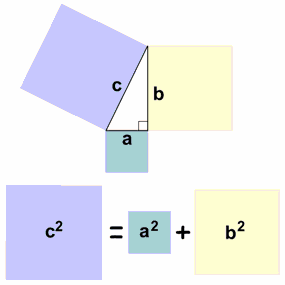
The formula of the Pythagorean Theorem is A squared +B squared =C squared (or on the top left of the picture)


The Right Triangle:
The right angle had a 90 degree angle. Of course something has to make that 90 degree angle, the leg A and B make up that angle.
The line across the 90 degree angle is the longest side which is called the hypotenuse.
There is also two other things that are in the right triangle that equals 90 degrees, these two are called theta and beta.


The Square:
The square always has sides that are all the same, all sides equal 90 degrees. When you split a square by cutting once across the 90 degree angle it makes two right triangles.
Two angles that equals to 90 degrees are called Complementary.
Angles that makes a straight line equals 180 degrees. And two angles are called Supplementary.


This was all invented by a Greek man named Pythagoras. Pythagoras is a mathematician,and a teacher/philosopher. He is also one of the most important mathematicians in the world.


In math class we made a video about how to solve to the "C" i hope you like it.


But wait we also made a second video on how to solve the "B" this time. I hope you like it.


Pythagoras


This man is Pythagoras.
Pythagoras made the proof of the right triangles. Pythagoras was a teacher and a Philosopher he is a very important person to mathematics. Pythagoras made the Pythagorean theorem which is:


This theorem is saying that A and B have a relationship with C:


Now we move to Triangles

Triangles are also called R.A.T. a right angle triangle. A right triangle has a hypotenuse the longest side to a triangle. A R.A.T also has legs and the right angle. There are also symbols in the corners of the triangle called theta and beta. Theta looks like a circle with a slash in the middle and beta looks like a B with a tail.


Now into Squares and Rectangles:

Squares and rectangles are in a group called quadrilaterals they have 4 sides and if you put 2 triangles you make a square or rectangle. They all make 360 degrees inside. A square has 4 equal sides and a rectangle has 2 long sides and 2 short sides.


Now on to 2 math problem

This one you have to find the bottom length.

A²+B²=C²

8x8+BxB=10x10

B²=100-64.............36

square root b² is B and the square root of 36 is 6 but there are two so you add 6+6 and the length side is 12mm.


Another Math problem


Firstly you can see that going around isn't the answer you cut across the yellow square find the side of C.

AxA + BxB = CxC
10x10 + 12x12=CxC
100+144=CxC
244=CxC
Square root 244 and you will get 15.6

Now you have the purple square you just add the bottom length so 10mm+ 2mm= 12mm
That is the shortest distance to A and B.


Movie will be uploaded soon.

Pythagoras


[photo taken from Mr.H's post]


This man is named Pythagoras. He was a teacher and philosopher in Greece, who was also vegan. Pythagoras was famous for calculating the circumference of the earth and realizing that the earth is a sphere and not flat. Pythagoras discovered the Pythagorean Theorem (a² + b² = c²).


This is the formula for the Pythagorean Theorem.


In this picture is a right triangle. R.A.T [ Right Angle Triangle]. The longest side of the triangle of the triangle is the hypotenuse. [side C= Hypotenuse]. The other two side are called the legs. [ side a & b= legs], and it doesn't matter which lines the letters go on. The legs both equal 90 degree angles. The square in the corner tells you that the lines equal a 90 degree angle. The sign in the corner that looks like a 'B' is called Beta and the sign that looks like a O with a line through it means theta.


This is a quadrilateral square. Quadrilateral means that all the side are the same length. The lines on each side of the chair indicate that each side is equal. In the corners of the square are the squares again, which means the sides make 90 degree angles. All the angles make up 360 degrees, therefore making the square equal 360 degrees.


pythagoras

Pythagoras Thereom

Pythagoras Theory

Wednesday, February 25, 2009


If you put any two triangles together you get a square or a rectangle like the one below.


These are quadralaterals they both have four sides and the


The sides that make up the angles can be called "legs" and can be called a or b so c is called the "hypotenuse."


make some cuts in "a" and arrange them around "b" to get "c"

And that is the jist of Pythagora's Theory

Pythagoras Post

This is Pythagoras :


Pythagoras is a greek mathematician. A teacher and a philosopher.
Pythagoras is one of the first important mathematician.

Pythagorean theorem :


Right triangle:

A right triangle has a 90 degree angle.
The leg a and b makes up that 90 degree angle.
From the 90 degree across, is where the long side is, the hypotenuse.
The theta and beta corners has to equal to a 90 degree to make a right triangle.


Square:

All sides of a square is the same. All the corners are 90 degrees.
When you split a square in half, it make 2 right triangles.

4= 90 degrees angles quadrilateral internal angles = 360 degrees.

Two angles that equals to 90 degrees are called Complementary. Angles that makes a straight line equals 180 degrees. And two angles are called Supplementary.

Were looking for the " a ". We know that " b " is 8 mm, and " c " is 10 mm.
So what i did is minus " b " to " c " and then I solved the exponents.
The when I got the exponents gone, I subtracted the answer of " c to b "
To get rid of the " a's " exponents you have to square root.
And what you do to the one side you do to the other side too .
So I square root the 36 and the " a " and got.. " a " = 6mm.
But were actually looking for two " a " because theres two triangles.
So you just added two " b's " which is " 6+6 " and got 12mm . " a = 12mm "


were trying to figure out what the diagonal is. So, i divided the square in half. and try to figure out what the long side. So we know that " a and b " is equals to 3 mm. So what i did is simplify " a and b exponents ". Then just add them together. And then, we square root to get the answer.


In this one, were trying to figure out the diagonal of the bigger square. I did the same thing as the first one. But instead of the " a and b " equals 3. In this one, " a and b " equals to 8mm.

Video: