Showing posts with label scribepost. Show all posts

Scribe Post for May 20, 2010

Thursday, May 20, 2010
Hello there, 9-05! Today we started on Chapter 10 which is Circle Geometry. We went straight to 10.1 and started learning or reviewing about circles since I'm sure most of us know something about circles. Chapter 10.1 is about Exploring Angles in a Circle. For this class, we spent our time taking down notes and Mr. B taught us how to find angles.
Circumference - The boundary of or distance around a circle.
Diameter - The distance across a circle through its centre.
Radius - A line segment joining the centre of a circle to the outside edge.


The angles ABC is called a Central Angle.
Central Angle - An angle form by two radii of a circle.
The straight yellow line from A to C is called a chord.
Chord - A line segment joining two points on the circumference of a circle.


Angles ADC and AEC are examples of Subtended Angles.
Subtended Angle: Lying opposite to.
Inscribed Subtended Angle: is equal to half the central triangle.

How do you find the measurement from B to C? Use Pythagoras!
First of all, why do we use Pythagoras? We can use Pythagoras method as long as there is a right triangle to find out the missing side length. Do you see the right triangle? If you flip it over or turn your head upside down, you will be able to see a right triangle. So, the angles AC will be represented as the hypotenuse which is c. And let's say that AB represents a and BC represents b.
a^2+b^2 = c^2
6^2+b^2 = 10^2
36+b^2 = 100
b^2 = 100-36
b^2 = 64
Square root b^2 = Square root 64
b = 8
The missing measurement of the line B to C is 8 cm.

Homework:
Chapter 10 Warm-Up #1
10.1 Textbook
-Practice, all odd
-Apply, all even
-Extend and any 2
10.1 Workbook
10.1 Worksheets

Well, that is all for now folks! (: I hope you enjoyed my post! Keep working hard 9-05! For exams are coming soon and we only got about a month of school left! The next scribe is KIM (:
Okay tootles!

Scribe Post April 27, 2009

Monday, April 27, 2009
Okay today in class we got our tests back and I'm sure that most of us were happy with our mark and some of us not so much. Today in class we were also talking about the problem with Carol Garden and Flat Bush, but I don't know if I have to do that one, so I'm not because my dad if about to unplug my internet, sorry.

Now for homework today we had nine questions for multiplying fractions I am going to do three different questions, so you can see how to do them. :]

My first question is one form the two that you had to draw a picture for.
The question is 4/5 x 1/2 or 1/2 of 4/5.
Now first I will solve it. So all I have to do is multiply the denominators and multiply the numerators.
(numerators) 4 x 1 = 4
(denominators) 5 x 2 = 10
4/5 x 1/2 = 4/10
Now simplify
4/10 = 2/5

PICTURE

I think that's how you make the picture, but I am not sure because well I just don't know how to draw a picture of multiply fractions.

The next question is 3/4 x 1/2 x 6/7=?
3 x 1 x 6 = 18
4 x 2 x 7 = 21
3/4 x 1/2 x 6/7 = 18/21
now simplify.
18/21 = 6/7
YAY!! I hope!

Okay next question is 9/10 x 5/18.
Now first I am going to switch around the 5 and the 9 because it doesn't matter which side it is on because you are multiplying them together anyways.
So now the question is 5/10 x 9/18 or 1/2 x 1/2, now that is much more friendly. :]

1 x 1 = 1
2 x 2 = 4
1/2 x 1/2 = 1/4

There I hope it helped. Sorry I didn't do all of them

Scribe Post for April 23, 2009

Sunday, April 26, 2009
Today in class we were disscussing what was the answer to this question.
Which lot more hard top?
Carol Gardens
3/4 of the lot will be playground for children.
2/5 of the playground will be hardtop for basketball.

Flatbush
2/5 of the lot will be playground for children.
3/4 of the playground will be hardtop for basketball.
The width is 100 meters and the length is 50 meters.
(both lots are the same size)
Draw a picture that shows the two lots to figure out the answer.
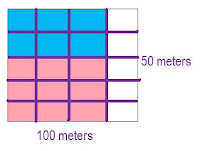
Carol Gardens
The pink shows how much playground is in carol gardens. This is 3/4 of the lot.

Now, we have to divide the playground (the pink) into fifths in order to get the answer. Once you cut 3/4 into fifths there would be 20 pieces but fifteen of the pieces is playground. We then have to change the denominator of 5 into a denominator of 15 so we could know how many squares to colour in. So, 2/5 times the bottom to 20 is 3. What you do to the top you do to the bottom so 2x3=6. So that means you have to colour in 6 out of 15 squares.


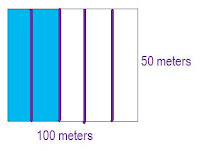
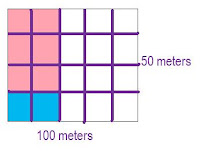
Flatbush
The blue part of this picture is how big is the playground in the lot. It is 2/5 of the lot.


We have to divide the playground (the blue) into fourths in order to get the answer. Cut 2/5 into fourths there would be 20 pieces but eight of the pieces is playground. We then have to change the denominator of 4 into a denominator of 8 so we could know how many squares to colour in. So, 3/4 times the bottom to 20 is 3. What you do to the top you do to the bottom so 3x2=6. So that means you have to colour in 6 out of 8 squares.


From the two pictures you could see that both of the hardtops are equivalent. They both make a fraction of 6/20. So, the answer is the Carol Gardens and the Flatbush have the same amount of hardtop on their playgrounds.

The next scribe is.... MAARC ! :D

Scribe Post

Sunday, April 19, 2009
On Friday we pretty much went over the homework from the day before, then we got a double-sided paper with a bunch of questions on it for homework.
Here's an example of an adding question. :]
A.
The first thing you have to do is find the common denominator. (it's best to find the lowest common denominator.)
The easiest way to find it is by multiplying the denominators. In this question, 4 multiplied by 5 gives you 20, which is the denominator. But multiplying isn't always the best solution.
Remember, what you do to the bottom, you must to do the top:
- you multiplied 4 by 5 to get 20, so you have to multiply 1 by 5, which gave you 5.
- you multiplied 5 by 4 to get 20, so you have to multiply 3 by 4, which gave you 12.
Last, add the numerators together, and you get your answer.


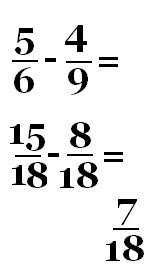
Here's an example of a subtraction question.
B.

Just like the last question, you have to find the smallest common denominator, which is 18. But you shouldn't multiply for this one. Instead, just look (or think) for the smallest common denominator that both numbers fit into.
Also like the last question, make sure you do the same to the top as you did to the bottom.
And last, you subtract the numerators, and then you get your answer.


Bracket question:
M.
In this question, you must do the brackets first. The same rules apply, you must find the lowest common denominator, which is 4. Make sure you do the same to the top as you did to the bottom, and then add the numerators.
Then, write the answer from the brackets (five eighths) and bring down the numbers outside of the brackets. Find the lowest common denominator, do the same to the top as you did to the bottom, add the numerators together, and you get your answer.


Word problem:
Q. Kent walked 3 fourths of a mile on Monday. On Tuesday, he walked 1 eighth of a mile less than on Monday. How far did he walk altogether?


Make sure you do both sides of the page! :]

Scribepost for april 14!!!!!!!!!

Tuesday, April 14, 2009
Homework For Today!!!!:):):):):):)
(Some information may not be accurate so try solving them yourselves)
For the next scribe I choose Eunice Cadao
Question 1 is 5/9+1/3=?


Question 2 1/4+2/5=?


Question 3 3/8+2/3=?


Question4 7/15+2/5=?

Scribe Post for March 16

Monday, March 16, 2009
Hi today i got to do the scribe post again because abby picked me so here's what we did today.
Today we did the colored booklet that was on the video on the blog.
so here's how the front should look like...


and here's the first page when you flip it should look like.(basically you just need to explain what each section means and you get them from the notes)


And here's the second page when you flip it twice.
You need to use the squares that we did on friday and cut them and put them whether they're perfect square or not perfect. and you need to put them in a number line formatic....


If you still need some help look at the video in the sargent park math zone or ask Mr. Harbeck for the papers..
For the next scribe i choose Marc

Scribe Post for March 13, 2009

Friday, March 13, 2009
I get to do a scribe post on Friday the 13th! Aren't I so lucky? (:

Okay so today in class, we added a few new things onto that big sheet with the square roots on it. We made sure that there was numbers 0 to 21 in the top number line.

Here's what we did on the top number line on the big sheet. I'm not going to do the whole thing though, only 0-5 (the words in the red are what we added) :


What we had to add here is what the square root would look like as a fraction. The 0 and 1 start off normally, but then after there's a mixed fraction. Let's look closely at how we got the numbers for this mixed fraction:


We do this for the next 15 numbers on the number line.

Here what we did for the second number line on the big sheet (the words in the red are what we added) :


For this number line, we had to add what the numbers on the bottom are when they are squared, and include the square root sign with them. We do this for the rest of the 15 numbers (the second row also has to have the number 0-21). After we finished the second number line, we had to find patterns within the number line. One pattern that my table group and I found is that the square root numbers on the top increase by odd numbers.


HOMEWORK:
  • On the back of the big sheet, write out how many patterns you can find on the number lines.

I hope this blog helped anyone who was away from school today! I was kind of having a hard time explaining things, so please comment if you think I missed out something! Have a great weekend guys! (:

The next scribe post-er I choose is .. FRANCIS!

Scribe Post March 11, 2008

Wednesday, March 11, 2009

Today in class we were talking about square roots.


What is a square root?


We had to use pictures, words and numbers to explain.


A square number is finding a root of a number that is squared.


HOMEWORK:
What is all the square roots between 1-19

SORRY, but the pictures that are supposed to be uploaded will not be available at the moment because of something happening to the computer. The picture will be posted up as soon as possible.

The next scribe IS... Nicko FRANCISCO !


Scribe Post March 9, 2009

Tuesday, March 10, 2009
On Monday, I was 10 minutes late. So I came in knowing nothing, but I asked a couple of my fellow students and I think I know now.
So, when i came in Mr. Harbeck had a multiplication chart on the smart board.
Then he talked about perfect squares.

The multiplication chart should look like this:

Then he made perfect squares with them,
The squares are perfect because the number is whole, if it has a decimal then it wouldn't be.


These are the perfect squares.


Then the homework.
The homework was to make a perfect squares chart.
It looks like this:

The second homework was this:
well, I think the first one is because it has equal sides.


I think that's all we did. :)
I'm really sorry if there are any mistakes, I'm pretty sure there are.
Well, time to pick the next scribe and I pick Mellisa B.

Scribe Post March 4, 2009

Wednesday, March 4, 2009

Yeah so yeah xD all the work is in the picture


Scribe Post

Today I am going to be talking about just one thing.

So today in class Mr. H put a question about a wire going from a tree to the roof of a house, and you had to figure out the length of the wire. Here's the question.

How long is the wire that runs from the base of the tree to the roof of the house in the drawing? Round to the nearest hundredth place.
From here on you just do what you normally do when you have a right triangle.

( Don't mind the cat hehe. That's my cat Felix by the way. :] )
a² + b² = c²
23² + 36² = c²
(23 x 23) + (36 x 36) = c²
484 + 1269 = c²
1780 = c²
√1780 = √c²
42.19 = c
Which then makes c 42.19.

That's really the only thing I have to put in my scribe today.

Remember:
- We have a test tomorrow.

- Also, do the rectangle homework (as well as this). There will be a scribe from someone else for that one. It is also on the blog.

Have a good night everyone!

Scribe Post

Tuesday, March 3, 2009
The Following times were recorded, in seconds. For the runners in a race.
20.2, 16.5, 40.4, 18.5, 21.4, 20.5, 17.1, 24.5, 19.0
What is the range of the times?
What are the mean and median of the times?
Identify any possible outliers. Should the Outlier(s) be removed from the data set?

The first thing you should do is arrange the data set in ascending order.

16.5, 17.1, 18.5, 19.0, 20.2, 20.5, 21.4, 24.5, 40.4
We will start with the range
to get the range you must take the greatest number and subtract the least from it.
Greatest - least = range
40.4 - 16.5 = 23.9
Next we will find the median this is where the ordering in ascending order comes in handy.
You have to find the middle number one way is to get rid of the ends so until you only have one or two numbers in the middle.


To get the mean you need to add up all the numbers in the data set and divide by how many numbers in the data set.

sum of all data 198.1
_________________ = 22.01

number of data 9

last we will find the outlier if there is one an outlier is a number that doesn't fit in in this case all the numbers are less than 25 but one which is 40.4 it is an outlier. sometimes an outlier will kill the set of data and destroy the mean with the outlier the mean is 22.o1 without the outlier it is 19.71 Sometimes it is smart to take out the outlier before finding the mean. For example it is smart to take it out so it doesn't completely mess up the mean.


we also did some triangles here are two of them of them.


Scribe Post for February 18th

Wednesday, February 18, 2009
Okay peoples, so in math today we went over the Pythagoras theory thing. So if you weren't listening then keep reading cause Im going to say everything we did in class (well almost everything (: ).

So what we discovered about pythagoras was that he was a greek guy who discovered the proof of the right triangle, and this is how it works.


so here we have right triangle


Right triangles of course have a right angle hence the name "right" triangle. Now a right triangle must have a 90 degree angle. So were would this 90 degree angle be?


See where the the little box is around the corner there, well it is marking where the right angle is. Thats how we know it is a right angle! Get it yet?


We also discovered that the to other angles which are called Theta and Beta equal 45 degrees.


But wait, theta and beta don't always have to be 45 degrees each. We did 45 degrees each because 4s is half of 90 and 45x2+90! see where we are going with this?


As long as theta and beta together equal 90 you good to go!


Now that we have covered the angles of the triangle lets move on.


So what I am getting to with the triangles is that when you put to right triangles together your going to get a square! OH SNAP!


so this is how it looks


SEE!
so 2 right triangle equals a square!
but remember it wil only work if theta and beta angles equal 90 degrees.
You can also do the same thing with rectangles the only difference is that all the sides aren't equal!
And there we have it!
If you weren't paying attentiong in class hopefully this helps you!


Tuesday, February 17, 2009

In class we learned about meking t-charts into graphs and finding the algebraic expressions for it

(sorry for the double post i pressed enter by mistake)

February 4, 2009 Scribe Post

Wednesday, February 4, 2009
Transposing
Definition? - to bring (a term) from one side of an equation to the other, with corresponding change of sign.

What is that??!! Here's a few examples.

What do you notice here? Where did the letter "x" (variable) go? Where did the constant go?
Well, the variable went to the left side of the equal sign and the constant on the right side. What did we really do? We simply placed all the constant on one side and the variable on the other.
Here's another example:

Okay, it's a bit messy but it's the best I can do. But here you can see the constant and variable getting separated into different sides of the equal sign. If you notice, after the transposing, it becomes a 1 step equation. Easy marks dudes and dudedettes.
Here's a rule or something you can keep in mind to help you:
Letter to the left,
Number to the right,
and just keep in balance,

Now try it for yourself!
-2k +19 = 3k -1

Alright fellas. Oh and ALWAYS VERIFY until Mr.Harbeck says so.

*leave a comment and your answer*
- nicko

Scribe post for feb,4

This scribe post is going to be about what you were supposed to put on the purple part of your multi colored booklet.

Collecting like terms and the Distributive property
Here is a question that has the same steps as the one in the booklet but the numbers are changed.

x+5(x+8)=58
This should be easy if you listened in class
x+5(x+8)=58
x+ 5x+40=58
6x+40=58
SOLVE

6x+40=58
-40 -40
6x=18
6/6 18/6

x=3

I hope that this is what I was supposed to write about. Odun can scribe.

Word Problems

Hi everyone today I'm going to talk about the test I did Which I got 16.5 out of 20.
I'm going to talk about three question to explain how to do word problems using algebra.
The first one would be,
Suppose you have $40 and earn $7 per hour. How many hours must you work until you have $131?


Mr. Piper's plumbing needed repairs. The plumber charged $98 for parts plus $45 per hour of labor. If the bill totaled $458, how many hour of labor wee required?


Mo is thinking of a number. Eleven more than one third of the number is -1


(Sorry I forgot how to do number six but if you know how comment me so I can learn it. The question is: A rectangular garden plot is 8m longer than it's wide. Find the dimension of the garden plot if it has a perimeter of 36 m.)Please leave a comment........:]:):>