Charissa, Katlyn and I made our video about animal abuse. It explains a few different kinds of abuse, as well as how you can help stop animal abuse.
Countless numbers of animals are killed each year because of animal cruelty..
Animal cruelty needs to be stopped.
If you want to learn more about animal cruelty, go to these sites:
http://www.hsus.org/acf/cruelty/
http://www.elmorehumane.com/Animal%20Abuse%20Info.htm
http://www.geocities.com/paws_n_tails/AnimalTestingFacts.html
(Just so you know ahead of time, some of the pictures in these sites are graphic.)
Showing posts with label Jessica16. Show all posts
Showing posts with label Jessica16. Show all posts

Scribe Post
On Friday we pretty much went over the homework from the day before, then we got a double-sided paper with a bunch of questions on it for homework.
Here's an example of an adding question. :]
A.
 The first thing you have to do is find the common denominator. (it's best to find the lowest common denominator.)
The easiest way to find it is by multiplying the denominators. In this question, 4 multiplied by 5 gives you 20, which is the denominator. But multiplying isn't always the best solution.
Remember, what you do to the bottom, you must to do the top:
- you multiplied 4 by 5 to get 20, so you have to multiply 1 by 5, which gave you 5.
- you multiplied 5 by 4 to get 20, so you have to multiply 3 by 4, which gave you 12.
Last, add the numerators together, and you get your answer.
Here's an example of a subtraction question.
B.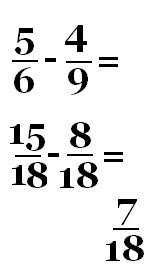
Just like the last question, you have to find the smallest common denominator, which is 18. But you shouldn't multiply for this one. Instead, just look (or think) for the smallest common denominator that both numbers fit into.
Also like the last question, make sure you do the same to the top as you did to the bottom.
And last, you subtract the numerators, and then you get your answer.
Then, write the answer from the brackets (five eighths) and bring down the numbers outside of the brackets. Find the lowest common denominator, do the same to the top as you did to the bottom, add the numerators together, and you get your answer.

Here's an example of an adding question. :]
A.
 The first thing you have to do is find the common denominator. (it's best to find the lowest common denominator.)
The easiest way to find it is by multiplying the denominators. In this question, 4 multiplied by 5 gives you 20, which is the denominator. But multiplying isn't always the best solution.
Remember, what you do to the bottom, you must to do the top:
- you multiplied 4 by 5 to get 20, so you have to multiply 1 by 5, which gave you 5.
- you multiplied 5 by 4 to get 20, so you have to multiply 3 by 4, which gave you 12.
Last, add the numerators together, and you get your answer.
Here's an example of a subtraction question.
B.
Just like the last question, you have to find the smallest common denominator, which is 18. But you shouldn't multiply for this one. Instead, just look (or think) for the smallest common denominator that both numbers fit into.
Also like the last question, make sure you do the same to the top as you did to the bottom.
And last, you subtract the numerators, and then you get your answer.
Bracket question:
M.
In this question, you must do the brackets first. The same rules apply, you must find the lowest common denominator, which is 4. Make sure you do the same to the top as you did to the bottom, and then add the numerators.M.

Then, write the answer from the brackets (five eighths) and bring down the numbers outside of the brackets. Find the lowest common denominator, do the same to the top as you did to the bottom, add the numerators together, and you get your answer.
Word problem:
Q. Kent walked 3 fourths of a mile on Monday. On Tuesday, he walked 1 eighth of a mile less than on Monday. How far did he walk altogether?
Q. Kent walked 3 fourths of a mile on Monday. On Tuesday, he walked 1 eighth of a mile less than on Monday. How far did he walk altogether?

Make sure you do both sides of the page! :]
Scribe Post
Today I am going to be talking about just one thing.
So today in class Mr. H put a question about a wire going from a tree to the roof of a house, and you had to figure out the length of the wire. Here's the question.
How long is the wire that runs from the base of the tree to the roof of the house in the drawing? Round to the nearest hundredth place.
That's really the only thing I have to put in my scribe today.
So today in class Mr. H put a question about a wire going from a tree to the roof of a house, and you had to figure out the length of the wire. Here's the question.
How long is the wire that runs from the base of the tree to the roof of the house in the drawing? Round to the nearest hundredth place.

From here on you just do what you normally do when you have a right triangle.
( Don't mind the cat hehe. That's my cat Felix by the way. :] )
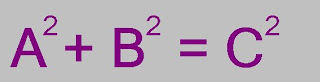
a² + b² = c²
23² + 36² = c²
(23 x 23) + (36 x 36) = c²
484 + 1269 = c²
1780 = c²
√1780 = √c²
42.19 = c
23² + 36² = c²
(23 x 23) + (36 x 36) = c²
484 + 1269 = c²
1780 = c²
√1780 = √c²
42.19 = c
Which then makes c 42.19.
That's really the only thing I have to put in my scribe today.
Remember:
- We have a test tomorrow.
- Also, do the rectangle homework (as well as this). There will be a scribe from someone else for that one. It is also on the blog.
Have a good night everyone!
Pythagoras
First thing's first...
R.A.T means Right Angle Triangle!
The right triangle has a 90 degree angle. The red square on the triangle shows where the 90 degree angle is.
The green symbol in the top corner of the triangle is called the Theta.
The grey symbol in the bottom corner of the triangle is called the Beta.
Together, the two angles (the Theta and the Beta) equal 90 degrees, they are complimentary.
The longest side of the triangle, the hypotenuse, is ALWAYS labeled as C.
The two other sides are labeled A and B (Note: it doesn't matter which side they go on!!! Although, an easy way to remember is A for Altitude (going up) and b for bottom, which is pretty self explanatory!) Together, side A and B make up the 90 degree angle. They are also called the legs of the triangle.


So at first, all I knew was that b is 8mm and c is 10mm.


R.A.T means Right Angle Triangle!
The right triangle has a 90 degree angle. The red square on the triangle shows where
 the 90 degree angle is.
The green symbol in the top corner of the triangle is called the Theta.
The grey symbol in the bottom corner of the triangle is called the Beta.
Together, the two angles (the Theta and the Beta) equal 90 degrees, they are complimentary.
The longest side of the triangle, the hypotenuse, is ALWAYS labeled as C.
The two other sides are labeled A and B (Note: it doesn't matter which side they go on!!! Although, an easy way to remember is A for Altitude (going up) and b for bottom, which is pretty self explanatory!) Together, side A and B make up the 90 degree angle. They are also called the legs of the triangle.
(the colours of the things in or around the triangle go with the colours of the words)
Pythagoras
 Pythagoras was the person who proved the Pythagorean Theorem.
 Pythagoras was the person who proved the Pythagorean Theorem.
 He was born in Greece, and was one of the first important math people.
No one really knows weather he did exist or not.
He really liked math and music.
He was a teacher, and a philosopher.
He was the one who figured out that the Earth is a sphere, the circumference of the Earth, and that the world revolved around the sun.
He was also the first vegan, he said he could hear his friends voice from a dog.
THE PYTHAGOREAN THEOREM

Pythagoras is famouse for proving the theorem.
Side a is the smallest, b the middle sized, and c the biggest.
You show this by taking b, and putting it into c, and then you cut a into certain sized pieces, and that proves that a² + b² = c².

Square.

A square has 4 right angles.
The internal angle is 360 degrees.
If you cut the square from one corner to the opposite corner, you'll have two triangles.
The single black lines on each side of the square tell you that all the sides are the same, they are lines of symmetry (indicating that this shape is a square and not a rectangle.)

A square has 4 right angles.
The internal angle is 360 degrees.
If you cut the square from one corner to the opposite corner, you'll have two triangles.
The single black lines on each side of the square tell you that all the sides are the same, they are lines of symmetry (indicating that this shape is a square and not a rectangle.)
Each side of the square is the same length.
Problem 1.

So at first, all I knew was that b is 8mm and c is 10mm.
And now, we have a, which is 6mm. But, there are two triangles, and side a on each is 6mm, which makes side a 12mm.
Problem 2.
A checkerboard is made of 64 small squares that each have a dimension of 3 cm X 3cm. The 64 small squares are arranged in eight rows of eight.
A. What is the length of the diagonal of a small square? Give your answer to the nearest tenth of a centimetre.

The length of the diagonal of a small square is 4.2cm.
Let C = length
a²+b²=c²
3²+3²=c²
9+9=c²
√18=√c²
4.2= c
B. What is the length of the diagonal of the board? Give your answer to the nearest centimetre.
B. What is the length of the diagonal of the board? Give your answer to the nearest centimetre.

The length of the diagonal of the board is 11cm Let C = length
a²+b²=c²
8²+8²=c²
(8x8) + (8x8) = c²
64+64=c²
√128 = c
11 = c
Video 1.
Video 2.
Video 2.
Scribe Post
Today we only did two things.
The first thing we did was correct the seven multiplication questions on page 43 of the purple booklet.
Here are the first two.
Number 1.

Remember, what you do to one side, you have to do to the other!
<------------------ Now isolate n (what you do to one side you must do to the other!!)
<------------------
Now Verify to check.
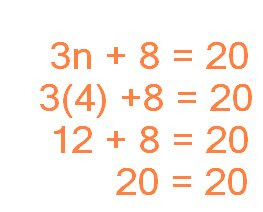
ALWAYS REMEMBER!!
<------------------ Number 2.

Balance
<------------------ Balance
<------------------
Now verify to check.
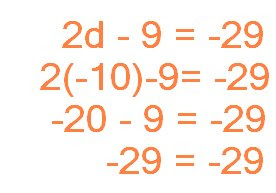
REMEMBER!
<------------------ Now onto the homework.
Here are a few examples.
Number 1.
Draw balance scales and blocks to represent each equation. Solve.
A. 2x + 5 = 9
= 9
Now verify to check.

Both sides are the same, therefore, they are balanced.
<------------------ Number 2.
Draw algebra tiles to model each answer. Solve.
A. 3x - 2 = 7
Now verify to check.

The next scribe is Mariah.
The first thing we did was correct the seven multiplication questions on page 43 of the purple booklet.
Here are the first two.
Number 1.

Remember, what you do to one side, you have to do to the other!
<------------------ Now isolate n (what you do to one side you must do to the other!!)
<------------------
Now Verify to check.

ALWAYS REMEMBER!!
<------------------ Number 2.

Balance
<------------------ Balance
<------------------
Now verify to check.

REMEMBER!
<------------------ Now onto the homework.
Here are a few examples.
Number 1.
Draw balance scales and blocks to represent each equation. Solve.
A. 2x + 5
 = 9
= 9Now verify to check.

Both sides are the same, therefore, they are balanced.
<------------------ Number 2.
Draw algebra tiles to model each answer. Solve.
A. 3x - 2 = 7

Now verify to check.

The next scribe is Mariah.
Pay it Forward
Pay it forward
So, this is what I did for the Pay it Forward thing. At first Charissa, Katlyn and I were going to go to Winnipeg Harvest and do stuff, but no one called back. We also thought about baking things like cookies and stuff like that and giving them to the soldiers who didn't get to spend Christmas with their families, but unfortunatly no one at the Armouries picked up the phone. So today we thought of other things we could possibly do on our own. So I sat at home thinking of what to do, so I decided to make supper for my family. I wasn't thinking and didn't take pictures or anything while I was making it, but I took a picture of the food after and interviewed my dad. It's kind of a silly video. The video was my idea, but he made up his lines. I was going to make a serious video about like if they liked it and stuff as well, but the cam corder card was full, so I didn't bother after that.

I made chicken, spaghetti squash and really yummy noodles!

I made chicken, spaghetti squash and really yummy noodles!
Okay... tragic thing. I can't figure out how to upload videos from my cam corder onto my computer. I got my mom and my brother to help me but no one could figure it out. Once I figure out how to upload the video onto my computer I'll edit my post and add it in!
The Great Big Book Of Algebra
Diamante Pattern 2:
Adding
All together, gain
Increasing, combining, enlarging
Greater than, more -- less, negative
Diminishing, decreasing, reducing
Less than, minus
Subtracting
Free Verse:
The day I learnt Pratt's law
I never thought,
not even once!
That I could be taught
Until one day,
as a matter of fact,
when I head someone say,
Do not fear!
She told me aloud,
Charissa is here!
She danced.
She pranced.
Then began to explain,
the very thing,
that put me in such pain.
And this.. is what she said.
While multiplying integers,
there's really no need to fuss.
This law is very simple,
so now I shall discuss.
When you multiply,
an even amount,
of negative integers that is,
you do not have to count,
in order to find the answer.
This, I can assure you.
Because the product is always positive!
But wait!
There's more!
She shouted in my ear.
That was only part one,
now this,
I tell ya'..
This ones more fun!
When you multiply an odd amount,
of negative integers,
The product is negative!
But, there's a twist!
She said,
then grinned.
No matter how many negative integers,
either an even,
or an odd amount.
If there is a zero among them,
the product is always zero!
She said,
then,
sat back down into her seat.
And from that day,
to the present,
all was well.
Haiku:
Partitive Division
Sharing equally
One is for you one's for me
Between equal groups
Free Verse:
Quotative Division
Quotative division,
is really not that hard.
As a matter of fact,
all it is saying,
is how many in each group!
Take 6 divided by 2,
for example.
All you need to do,
is find how many groups,
of two,
are in six!
Haiku:
Subtraction
You never subtract
Instead, add the opposite
Subtracting is bad!
Chapter Two:
Combining like Terms
and the
distributive property
This is the script of what my people are going to say. :]
Tom: Good day mate! My name's Tom!
Jimothy: Hi Tom! My name's Jimothy! Are you smart Tom?
Tom: You bet I am! Why do you ask?
Jimothy: Well.. I need some help with my homework. We're combining like terms and distributive property. There are two questions we have to do, the first one is n+3 - 5n+11.
Tom: That's easy! But I don't just want to give you the answer, what do you think the answer is?
Jimothy: I think the answer is 6n + 14.
Tom: Okay, so let's go through the steps. First, you have to combined the like terms.
Jimothy: So.. would it be n and -5n in brackets? And three and eleven in brackets? Like this (n - 5n) + (11 + 3) ?
Tom: Yep, good! Now remember only one thing can come out of the brackets, what is n - 5n?
Jimothy: I think it would be... -4n?
Tom: Yes sir! Now what is 3 + 11?
Jimothy: 14.
Tom: Soooo... what would the answer be?
Jimothy: Ummm... -4n + 14?
Tom: That's right mate! The only thing you did wrong before was that you took away 6n from n, instead of 5n.
Jimothy: Oh okay! So the second question is 2 (n +4).
Tom: What do you think the answer is?
Jimothy: I think the answer is 2 x 4n.
Tom: Nope. The first thing you do, is times n by 2, which gives you?
Jimothy: 2n?
Tom: Yep! Now, you have to times 4 by 2, which is?
Jimothy: 8!
Tom: That's right! Now, what do you think the answer is?
Jimothy: 2n + 8?
Tom: That's right!
Jimothy: That's all there is to it?
Tom: You bet!
Jimothy: Gee thanks Tom!
Tom: No problem kid!
Chapter 4
Adding
All together, gain
Increasing, combining, enlarging
Greater than, more -- less, negative
Diminishing, decreasing, reducing
Less than, minus
Subtracting
Free Verse:
The day I learnt Pratt's law
I never thought,
not even once!
That I could be taught
Until one day,
as a matter of fact,
when I head someone say,
Do not fear!
She told me aloud,
Charissa is here!
She danced.
She pranced.
Then began to explain,
the very thing,
that put me in such pain.
And this.. is what she said.
While multiplying integers,
there's really no need to fuss.
This law is very simple,
so now I shall discuss.
When you multiply,
an even amount,
of negative integers that is,
you do not have to count,
in order to find the answer.
This, I can assure you.
Because the product is always positive!
But wait!
There's more!
She shouted in my ear.
That was only part one,
now this,
I tell ya'..
This ones more fun!
When you multiply an odd amount,
of negative integers,
The product is negative!
But, there's a twist!
She said,
then grinned.
No matter how many negative integers,
either an even,
or an odd amount.
If there is a zero among them,
the product is always zero!
She said,
then,
sat back down into her seat.
And from that day,
to the present,
all was well.
Haiku:
Partitive Division
Sharing equally
One is for you one's for me
Between equal groups
Free Verse:
Quotative Division
Quotative division,
is really not that hard.
As a matter of fact,
all it is saying,
is how many in each group!
Take 6 divided by 2,
for example.
All you need to do,
is find how many groups,
of two,
are in six!
Haiku:
Subtraction
You never subtract
Instead, add the opposite
Subtracting is bad!
Chapter Two:
Combining like Terms
and the
distributive property
This is the script of what my people are going to say. :]
Tom: Good day mate! My name's Tom!
Jimothy: Hi Tom! My name's Jimothy! Are you smart Tom?
Tom: You bet I am! Why do you ask?
Jimothy: Well.. I need some help with my homework. We're combining like terms and distributive property. There are two questions we have to do, the first one is n+3 - 5n+11.
Tom: That's easy! But I don't just want to give you the answer, what do you think the answer is?
Jimothy: I think the answer is 6n + 14.
Tom: Okay, so let's go through the steps. First, you have to combined the like terms.
Jimothy: So.. would it be n and -5n in brackets? And three and eleven in brackets? Like this (n - 5n) + (11 + 3) ?
Tom: Yep, good! Now remember only one thing can come out of the brackets, what is n - 5n?
Jimothy: I think it would be... -4n?
Tom: Yes sir! Now what is 3 + 11?
Jimothy: 14.
Tom: Soooo... what would the answer be?
Jimothy: Ummm... -4n + 14?
Tom: That's right mate! The only thing you did wrong before was that you took away 6n from n, instead of 5n.
Jimothy: Oh okay! So the second question is 2 (n +4).
Tom: What do you think the answer is?
Jimothy: I think the answer is 2 x 4n.
Tom: Nope. The first thing you do, is times n by 2, which gives you?
Jimothy: 2n?
Tom: Yep! Now, you have to times 4 by 2, which is?
Jimothy: 8!
Tom: That's right! Now, what do you think the answer is?
Jimothy: 2n + 8?
Tom: That's right!
Jimothy: That's all there is to it?
Tom: You bet!
Jimothy: Gee thanks Tom!
Tom: No problem kid!
Chapter 4
Jessica's Scribe Post
Scribe Post
Monday, October 27
Subtracting Integers
Homework
Today for homework we have to do page 46 in the yellow book. Make sure you remember to do three of the questions using integer tiles!
Next scribe : RAYNA! xP
Monday, October 27
Subtracting Integers
Today in class we learned how to subtract integers. The thing is, you DON'T subtract them, you add the opposite.
For example. (-1) - (+1) THIS IS WRONG!!
In order to make this correct, you must change the subtraction sign (-) to a plus sign (+).
Then, you change the (+1) to a (-1)
You start with this... (-1) - (+1)
And end up with this... (-1) + (-1) = good! :]
Actually it equals (-2)
Always remember! Don't change the first integer! Only change the subtraction sign (-) to a plus sign (+). Then you change the second integer to it's opposite. Which in this case would be (+1) to (-1).
Integer Tiles
You use integer tiles to help you figure out the answers when you add integers.
(+4) + (-3)=? (Remember the red tiles are positive, the white ones are negative!)
 So, since there is only one left, the answer is (+1).
For example. (-1) - (+1) THIS IS WRONG!!
In order to make this correct, you must change the subtraction sign (-) to a plus sign (+).
Then, you change the (+1) to a (-1)
You start with this... (-1) - (+1)
And end up with this... (-1) + (-1) = good! :]
Actually it equals (-2)
Always remember! Don't change the first integer! Only change the subtraction sign (-) to a plus sign (+). Then you change the second integer to it's opposite. Which in this case would be (+1) to (-1).
Integer Tiles
You use integer tiles to help you figure out the answers when you add integers.
(+4) + (-3)=? (Remember the red tiles are positive, the white ones are negative!)
 So, since there is only one left, the answer is (+1).
Homework
Today for homework we have to do page 46 in the yellow book. Make sure you remember to do three of the questions using integer tiles!
Next scribe : RAYNA! xP
Jessica's Integer Story
Once upon a time in a far away land lived a dragon named Fredward. He loved to do math, just kidding he hated it but he was good at it. Every time he tried to blow flames at the knights who tried to rescue the princess he blew out integer problems instead of fire.
One dark and stormy night a knight went to the castle to rescue the princess. Fredward flew up to him and tried to blow fire at him, but instead blew an integer problem. The knight laughed and said "(-5) + (+6) is positive one! Bwuahahaha! You fool." Then he ran off laughing. Since he wasn't watching where he was going because he was laughing so hard, he tripped and fell into one of the traps in the castle. He had no way out. Luckily for Fredward the knights would always do the exact same thing, and he could torture them with math questions! Though he wished he could blow fire instead of math questi ons.
ons.
A few weeks later two more knights came looking for the princess together. They split up to look for the princess. Fredward flew up to one of them scaring them half to death. But, once he blew an integer problem at them the knight laughed and said "Positive 8 plus negative 16 equals negative 8! Your not so scary! Hahahaha!" Like usual, the knight fell into one of the traps. So Fredward went looking for the other knight. Once he found him he blew (+1) + (+1) at the knight. But only this time the Knight was laughing so hard that he simply turned around and went home.

The very same day another knight came along. Fredward flew up to him and just like that he blew an integer problem at him. The knight burst out laughing then said "A dragon that blows math questions? Oh how wonderfully pathetic! And the question isn't even challenging! Negative 11 plus positive 4 equals negative 7! How pathetic! My cat could give a harder math question than that! Step aside you math geek and let me rescue the princess!" This truely engranged Fredward. He spread his wings and took a deep breath, then forcefully blew it all out at the knight. No math questions! He had finally learned how to blow fire! After he had fried the knight he celebrated by gobbling him up. No other knight had enough time to fall into one of the traps, until one day...

A few days later when Fredward was still not feeling good a knight named Prince Billy came along to rescue the princess. Fredward flew to him. But Prince Billy stood tall with his sword in his hand getting ready to slay Fredward, but then Fredward blew the question (+2) - (-5). Prince Billy dropped his sword, and stared with horror and screamed at the top of is lungs. "A..a..a math question! Oh no! I don't know how to do math!" And then he shreaked like a little girl. Before Prince Billy was able to run Fredward ate him. soon after Fredward sneezed, and he was able to breath again! And suddenly his throaght wasnt sore anymore! Fredward was so happy that he was feeling better that he invited his friends Cosmo and Jimothy over to party. The end.
end.
One dark and stormy night a knight went to the castle to rescue the princess. Fredward flew up to him and tried to blow fire at him, but instead blew an integer problem. The knight laughed and said "(-5) + (+6) is positive one! Bwuahahaha! You fool." Then he ran off laughing. Since he wasn't watching where he was going because he was laughing so hard, he tripped and fell into one of the traps in the castle. He had no way out. Luckily for Fredward the knights would always do the exact same thing, and he could torture them with math questions! Though he wished he could blow fire instead of math questi
 ons.
ons.A few weeks later two more knights came looking for the princess together. They split up to look for the princess. Fredward flew up to one of them scaring them half to death. But, once he blew an integer problem at them the knight laughed and said "Positive 8 plus negative 16 equals negative 8! Your not so scary! Hahahaha!" Like usual, the knight fell into one of the traps. So Fredward went looking for the other knight. Once he found him he blew (+1) + (+1) at the knight. But only this time the Knight was laughing so hard that he simply turned around and went home.

The very same day another knight came along. Fredward flew up to him and just like that he blew an integer problem at him. The knight burst out laughing then said "A dragon that blows math questions? Oh how wonderfully pathetic! And the question isn't even challenging! Negative 11 plus positive 4 equals negative 7! How pathetic! My cat could give a harder math question than that! Step aside you math geek and let me rescue the princess!" This truely engranged Fredward. He spread his wings and took a deep breath, then forcefully blew it all out at the knight. No math questions! He had finally learned how to blow fire! After he had fried the knight he celebrated by gobbling him up. No other knight had enough time to fall into one of the traps, until one day...

After Fredward had eaten one of the knights that had recently tried to save the princess, he cought the knights cold. One day when he was laying in bed, not feeling well at all, another knight came along. Since this was Fredwards job and didn't want to get fired, he got up and slowly flew up to the knight and tried to blow fire. But tragedy has struck! Since Fredward is sick he isn't able to blow fire, but he can blow math question! The knight laughed. "(+10) - (-5) is 5!" Fredward laughed and said "Foolish human, you have to change the subtraction sign to a plus sign and then change -5 to positive 5! Bahaha! (cough cough)" Then Fredward quickly bent down and gobbled the knight.

A few days later when Fredward was still not feeling good a knight named Prince Billy came along to rescue the princess. Fredward flew to him. But Prince Billy stood tall with his sword in his hand getting ready to slay Fredward, but then Fredward blew the question (+2) - (-5). Prince Billy dropped his sword, and stared with horror and screamed at the top of is lungs. "A..a..a math question! Oh no! I don't know how to do math!" And then he shreaked like a little girl. Before Prince Billy was able to run Fredward ate him. soon after Fredward sneezed, and he was able to breath again! And suddenly his throaght wasnt sore anymore! Fredward was so happy that he was feeling better that he invited his friends Cosmo and Jimothy over to party. The
 end.
end.Jessica's Measures Of Central Tendancy
Mean - Arrange the set of data in ascending order. Then add up all the numbers and divide the answer by the number of numbers.

http://www.mathsisfun.com/mean.html
Median - Arrange the set of data in ascending order. The number in the middle is the median. If there is two numbers in the middle, add them and then divide them by two.
http://www.mathsisfun.com/median.html
Mode - Arrange the set of data in ascending order. The number that shows up the most is te mode. There can be no mode if each of the numbers only appears once.

http://www.mathsisfun.com/mode.html

http://www.mathsisfun.com/mean.html
Median - Arrange the set of data in ascending order. The number in the middle is the median. If there is two numbers in
 the middle, add them and then divide them by two.
http://www.mathsisfun.com/median.html
Mode - Arrange the set of data in ascending order. The number that shows up the most is te mode. There can be no mode if each of the numbers only appears once.

http://www.mathsisfun.com/mode.html
Range - Arrange the set of data in ascending order. Subtracting the smallest number from the biggest number gives you the range.

http://www.mathgoodies.com/lessons/vol8/range.html
http://www.mathgoodies.com/lessons/vol8/range.html
Subscribe to:
Posts (Atom)


