Rayna, Samantha, Kelsey, Gennia... 8-16
Child labour is so cruel! No child deserves to have their child hood taken away for them and be forced to work crazy long hours, at crazy young ages. Child labour needs to stop and it starts with one!
Showing posts with label NGO 8-16. Show all posts
Showing posts with label NGO 8-16. Show all posts
To borrow or to be improper
To borrow or be improper...
I don't really know how, but i will explain the best i can
The question is 50 1/10 - 25 4/5 when you do this without borrowing it would look like this
50 1/10 - 25 8/10 , 1/10 - 8/10 is kind of impossible ...
So you have to borrow . We will borrow from 50 1/10
All you need to borrow in this question is one , just enough so you can subtract 8
I don't really know how, but i will explain the best i can
The question is 50 1/10 - 25 4/5 when you do this without borrowing it would look like this
50 1/10 - 25 8/10 , 1/10 - 8/10 is kind of impossible ...
So you have to borrow . We will borrow from 50 1/10
All you need to borrow in this question is one , just enough so you can subtract 8
I will just take 1 away from 50 = 49 , now give that extra number to the numerator that makes 11 because 1 whole number equals ten tenths.
now it will look like 49 11/10
now you can subtract 49 11/10 - 25 4/5
49 - 25 = 26
change the fractions from 4/5 to 8/10
11/10 - 8/10 = 3/10
26 3/10 is the answer :)
49 - 25 = 26
change the fractions from 4/5 to 8/10
11/10 - 8/10 = 3/10
26 3/10 is the answer :)
Scribepost for January 12
Scribepost for today.
Harbeck gave us questions that will probably be on the test because he clearly said "I'm lazy".
these are all the questions : n-6= 14
n+9= -4
-9+n= 17
25= -12+n
n- (-6)= 15
-n/ 5= 6
-30n = 180
1/4n= 12
n/4=12
- 1/5n= 10 [ NOTE: the negative sign is in the middle so you can choose which one you'd rather put it on ]
12n= 48
I'm guessing that most of those questions will be on the test. I want to choose 1 that i will solve with algebra tiles and the other way? ( i don't remember what it's called ) .
i chose , n+9= -4
easy right? First you need to isolate the "n". To isolate it you need to cancel out the +9 to do that you need a zero pair. This picture below explains most of it. In the picture i forgot to write VERIFY, but the (-4 = -4 ) pretty much explains it.

I also want to do this one in algebra tiles .

I'm sorry it's blurry but it was way bigger when i made it. This picture actually took a long time to make so i don't really want to make anymore. I'm sorry but i will solve 3 more other questions.
25= -12+n for this one you can turn it around so it's easier to solve.
so it can be 12+n= 25
the next thing you need to do is ISOLATE , all the steps together are " ICOBV " which means , isolate; cancel - opposites ; balance and verify.
-12 + 12 +n = 25 - 12
n = 13
REWRITE :
12+n=25
12+13= 25
25=25
The next question i will do is : - 30n = 180
you need to divide since this dividing is the opposite of multiplying
n = 180 / -30
n = -6
this might look confusing but it's not . N = 180 divided by -30 .
i don't know if mr. Harbeck did it like this but the answer still seems to be right.
rewrite it : -30n = 180
-30(-6) = 180
180 = 180
next question : 12n = 48 "/ " means divide by [opposite of multiply is divide]
12n / -12 = 48 / -12
isolates n = 48 / 12
n = 4
rewrite it ! 12n= 48
12(4) = 48
48 = 48
I'm sorry , if it wasn't understandable or if any of them are wrong .
Harbeck gave us questions that will probably be on the test because he clearly said "I'm lazy".
these are all the questions : n-6= 14
n+9= -4
-9+n= 17
25= -12+n
n- (-6)= 15
-n/ 5= 6
-30n = 180
1/4n= 12
n/4=12
- 1/5n= 10 [ NOTE: the negative sign is in the middle so you can choose which one you'd rather put it on ]
12n= 48
I'm guessing that most of those questions will be on the test. I want to choose 1 that i will solve with algebra tiles and the other way? ( i don't remember what it's called ) .
i chose , n+9= -4
easy right? First you need to isolate the "n". To isolate it you need to cancel out the +9 to do that you need a zero pair. This picture below explains most of it. In the picture i forgot to write VERIFY, but the (-4 = -4 ) pretty much explains it.

I also want to do this one in algebra tiles .

I'm sorry it's blurry but it was way bigger when i made it. This picture actually took a long time to make so i don't really want to make anymore. I'm sorry but i will solve 3 more other questions.
25= -12+n for this one you can turn it around so it's easier to solve.
so it can be 12+n= 25
the next thing you need to do is ISOLATE , all the steps together are " ICOBV " which means , isolate; cancel - opposites ; balance and verify.
-12 + 12 +n = 25 - 12
n = 13
REWRITE :
12+n=25
12+13= 25
25=25
The next question i will do is : - 30n = 180
you need to divide since this dividing is the opposite of multiplying
n = 180 / -30
n = -6
this might look confusing but it's not . N = 180 divided by -30 .
i don't know if mr. Harbeck did it like this but the answer still seems to be right.
rewrite it : -30n = 180
-30(-6) = 180
180 = 180
next question : 12n = 48 "/ " means divide by [opposite of multiply is divide]
12n / -12 = 48 / -12
isolates n = 48 / 12
n = 4
rewrite it ! 12n= 48
12(4) = 48
48 = 48
I'm sorry , if it wasn't understandable or if any of them are wrong .
Pay it Forward
Paying it forward was hard, it was hard to try to make a difference big enough to be noticed. I don't think i made a big difference but i did try. I think people should be very appreciative of what they have even if they don't have much it's the small stuff you need to pay attention too. I made small cards kind of explaining pay it forward and trying to make them notice that being happy is important. I didn't want to hand it out personally because i was afraid of people just thinking of it as nothing. Even though shoveling snow would be easier it just wouldn't be the same. After i did put them in mail boxes which was brave because I'm to shy to go onto other peoples property. It did make me want to know if the people actually took what i wrote into consideration. Gennia and I also did this, i couldn't do all of it by myself even if she was sick!
 my booklets were small, and simple but its the inside that counts. It says please pay it forward. And " paying it forward doesn't mean paying money it means to make a change in someones life and knowing what good things you have and convincing others to do the same.

 more pictures there just not uploaded yet!
 my booklets were small, and simple but its the inside that counts. It says please pay it forward. And " paying it forward doesn't mean paying money it means to make a change in someones life and knowing what good things you have and convincing others to do the same.
 more pictures there just not uploaded yet!
The Great Big Book of Algebra
Integer Poems
[ note: some of them are kind of boring, well mostly the free-verse and i don't know how to spell the multiplicitive inverse? ]
Adding integers; Cinquain
ADDING
positive,easy
combining, gaining, increasing
the opposite of subtracting
PLUS
Subtracting integers; Haiku
It does not exist
the difference between numbers
add the opposite.
Partitive Division; Tanka
Groups of integers
sharing between many groups
fraction of some sort
the product of a question
multiplicitive inverse.
Quotative Division; free verse
how many ?
positive or negative integers
are in positives and negatives
this is sometimes impossible
but you are making groups
sometimes you need the
MULTIPLICITIVE INVERSE.
Pratts Law; free verse
when you've got an odd amount
there really is no need to count
all you need to remember is
odd is negative and even
is a positve
your sum will
always be correct
there is no need to fret.
chapter 2 ; combining like terms and distributive property
mommy: Hello daughter
daughter: hello mommy
mommy: anything worth learning happen today?
daughter: not really, i have two math questions to do.
mommy: let's see them!
daughter: n+3-5n+12
and 2+4 (3n+8) what does this mean? and how can i do this.
mommy: let's do the first one n+3-5n+12
look at this question carefully do you recognize anything?
daughter: yeah i see adding and subtracting but why is there an "n".
mommy: that represents a number, but we just don't know it yet.
daughter: ok then.
mommy: now combine like terms, it's when you add things that are alike. n+5n its like regular adding integers or when its just an "n" think of it as 1. n+5n=6n
daughter: i get it, you can subtract 12 and 3 to get 15! is that right?
mommy: Yes it is! and you can't add, for example 5+9n because those are not like terms. and remember its easier if you re-write it.
daughter: n+5n=6n and 3-12 equals 15 so now its just 6n+ 15?
mommy: Right!
daughter: how about the second one!
mommy: 2+4 (3n+8) we need to use the distributive property. which is like simplifying!
daughter: Ok how do i do that?
mommy: first you need to multiply the number next to the bracket with the two numbers on the inside of the bracket 2+4 (3n+8) so figure that out.
daughter: 4x3n= 12n and 4x8=32?
mommy: Yeah!
daughter: now what do i do with the 2?
mommy: It's kind of like adding like terms,
daughter: 2+32? Oh! i get it! 32+2=34 then put it all together! 12n+34
mommy: Yeah! i know your right!
CHAPTER 3 :One Step Solving Equation
additive type , it is pretty much explained but i'll say it again. Always isolate the variable by doing the opposite. In additive it is subtractive so whatever you do to one side you do to the other. It's all shown in my picture. By the way it's the same picture as the one in my scribe.

This second one is subtractive which is really like adding.
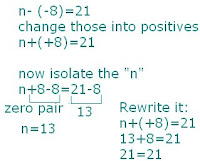
third one is the division one? It looks different and when you isolate by using the opposite you would use multiplication.

this one is the muliplication one and sorry i don't remember what there called. This one is simple, well all of them are if you remember to isolate by using the opposite and know how to add,subtract,mulitply and divide :) i do this one two different ways i'll show you down there. This first one is what Mr.Harbeck uses.

I write it differently but it still works

[ note: some of them are kind of boring, well mostly the free-verse and i don't know how to spell the multiplicitive inverse? ]
Adding integers; Cinquain
ADDING
positive,easy
combining, gaining, increasing
the opposite of subtracting
PLUS
Subtracting integers; Haiku
It does not exist
the difference between numbers
add the opposite.
Partitive Division; Tanka
Groups of integers
sharing between many groups
fraction of some sort
the product of a question
multiplicitive inverse.
Quotative Division; free verse
how many ?
positive or negative integers
are in positives and negatives
this is sometimes impossible
but you are making groups
sometimes you need the
MULTIPLICITIVE INVERSE.
Pratts Law; free verse
when you've got an odd amount
there really is no need to count
all you need to remember is
odd is negative and even
is a positve
your sum will
always be correct
there is no need to fret.
chapter 2 ; combining like terms and distributive property
mommy: Hello daughter
daughter: hello mommy
mommy: anything worth learning happen today?
daughter: not really, i have two math questions to do.
mommy: let's see them!
daughter: n+3-5n+12
and 2+4 (3n+8) what does this mean? and how can i do this.
mommy: let's do the first one n+3-5n+12
look at this question carefully do you recognize anything?
daughter: yeah i see adding and subtracting but why is there an "n".
mommy: that represents a number, but we just don't know it yet.
daughter: ok then.
mommy: now combine like terms, it's when you add things that are alike. n+5n its like regular adding integers or when its just an "n" think of it as 1. n+5n=6n
daughter: i get it, you can subtract 12 and 3 to get 15! is that right?
mommy: Yes it is! and you can't add, for example 5+9n because those are not like terms. and remember its easier if you re-write it.
daughter: n+5n=6n and 3-12 equals 15 so now its just 6n+ 15?
mommy: Right!
daughter: how about the second one!
mommy: 2+4 (3n+8) we need to use the distributive property. which is like simplifying!
daughter: Ok how do i do that?
mommy: first you need to multiply the number next to the bracket with the two numbers on the inside of the bracket 2+4 (3n+8) so figure that out.
daughter: 4x3n= 12n and 4x8=32?
mommy: Yeah!
daughter: now what do i do with the 2?
mommy: It's kind of like adding like terms,
daughter: 2+32? Oh! i get it! 32+2=34 then put it all together! 12n+34
mommy: Yeah! i know your right!
CHAPTER 3 :One Step Solving Equation
additive type , it is pretty much explained but i'll say it again. Always isolate the variable by doing the opposite. In additive it is subtractive so whatever you do to one side you do to the other. It's all shown in my picture. By the way it's the same picture as the one in my scribe.

This second one is subtractive which is really like adding.

third one is the division one? It looks different and when you isolate by using the opposite you would use multiplication.

this one is the muliplication one and sorry i don't remember what there called. This one is simple, well all of them are if you remember to isolate by using the opposite and know how to add,subtract,mulitply and divide :) i do this one two different ways i'll show you down there. This first one is what Mr.Harbeck uses.

I write it differently but it still works

Kelsey's Integer story
Nago loved secrets, she loved talking to people about things she shouldn't really know. Nago had been trustworthy but it depends on the secret. Then one day at school someone gave her a note in her locker. It was marked with "anon". To her it wasn't really a secret just a bunch of numbers. All she can think was, who was this and why these numbers, and more importantly what do they mean?

Weeks later no one really had anything going on, there wasn't much secrets and gossip in the air. Nago realized that once everything had died down she had nothing to do. But again after her phys-ed class she changed from her shorts to her jeans and found another note. It had different numbers and she'd seen them before.

Woah! Nago knows this stuff, she realizes that it's math! She's not sure what kind of math. But it reminds her of the weather. Nago is really curious to know more about it and how she can use it. In each new note the question has been solved in different ways.

Another day ends with Nago leaving school. She does the regular things, goes to her locker then picks up her stuff and leaves. As she expected theres another note in her locker. She notices that all of her problems have been adding, but she wonders can these numbers be subtracted? She looks into all of this math and guess what she finds!

.... To be continued ?
Yeah, Nago is back! She finds another note, but this time it's different. It says "If you don't solve this question you will not find out who this is, and why i am doing this". Nago wants to solve this question really bad but she can't really figure it out. Then poof! she get's it.

Finally she finds the last note in her binder in her math section. Wow what a coincidence! Anyways as she had planned, her answer was right so she got the next note. It had a bunch of different number and signs on it. But she wanted to know who was challenging her with all of these questions so she answered it.

Then she received a phone call saying to her that she has learned plenty and it should stay this way. She thinks that all of this was for nothing but maybe it wasn't.
DUN DUN DUN !

Weeks later no one really had anything going on, there wasn't much secrets and gossip in the air. Nago realized that once everything had died down she had nothing to do. But again after her phys-ed class she changed from her shorts to her jeans and found another note. It had different numbers and she'd seen them before.

Woah! Nago knows this stuff, she realizes that it's math! She's not sure what kind of math. But it reminds her of the weather. Nago is really curious to know more about it and how she can use it. In each new note the question has been solved in different ways.

Another day ends with Nago leaving school. She does the regular things, goes to her locker then picks up her stuff and leaves. As she expected theres another note in her locker. She notices that all of her problems have been adding, but she wonders can these numbers be subtracted? She looks into all of this math and guess what she finds!

.... To be continued ?
Yeah, Nago is back! She finds another note, but this time it's different. It says "If you don't solve this question you will not find out who this is, and why i am doing this". Nago wants to solve this question really bad but she can't really figure it out. Then poof! she get's it.

Finally she finds the last note in her binder in her math section. Wow what a coincidence! Anyways as she had planned, her answer was right so she got the next note. It had a bunch of different number and signs on it. But she wanted to know who was challenging her with all of these questions so she answered it.

Then she received a phone call saying to her that she has learned plenty and it should stay this way. She thinks that all of this was for nothing but maybe it wasn't.
DUN DUN DUN !
scribepost wednesday 8 2008
In class today we played a game, Is this game fair?
heres the rules :D
1) There are two participants, one PLAYER and one OPPONENT.
only the PLAYER will roll the number cubes.
2) each person will start off with 10 points
3) each time the PLAYER rolls a seven on the number cubes, the OPPONENT must give them
three of their 10 points.
4) If the PLAYER rolls anything other than the seven he/she must give one point to the OPPONENT
You must record the results of each roll a chart like this !

The first person after ten rolls with the most points wins .
The other thing we did in class was a car game
there is a red car and a blue car :
you roll the die to get one of these six numbers.
the red car moves on 2,4,6
the blue car moves on 1,3,5
The car too reach the end wins .
In class harbeck played this game , and the blue car won .
After , we needed a different way but still make it fair.
red car moves on 1,2,3
blue car moves on 4,5,6
It's still fair, because each car has a 50/50 chance of winning.
one way too make , the red car will always win is chosing numbers like this :
red car : 1,2,3,4,5
blue car : 6

the next scriber i chose is : Christian
heres the rules :D
1) There are two participants, one PLAYER and one OPPONENT.
only the PLAYER will roll the number cubes.
2) each person will start off with 10 points
3) each time the PLAYER rolls a seven on the number cubes, the OPPONENT must give them
three of their 10 points.
4) If the PLAYER rolls anything other than the seven he/she must give one point to the OPPONENT
You must record the results of each roll a chart like this !

The first person after ten rolls with the most points wins .
The other thing we did in class was a car game
there is a red car and a blue car :
you roll the die to get one of these six numbers.
the red car moves on 2,4,6
the blue car moves on 1,3,5
The car too reach the end wins .
In class harbeck played this game , and the blue car won .
After , we needed a different way but still make it fair.
red car moves on 1,2,3
blue car moves on 4,5,6
It's still fair, because each car has a 50/50 chance of winning.
one way too make , the red car will always win is chosing numbers like this :
red car : 1,2,3,4,5
blue car : 6
the next scriber i chose is : Christian
kelsey's measures of central tendency
Mean :

Range :
when you subtract the smallest number in the data set by the biggest number in the data set.

Here is my movie on mmm
Taking a group of numbers adding them all together, then divide them by how many numbers are in the set.

Median :

Median :
First arrange them in ascending order .
It is the middle number in a data set.
if there are two number in the middle add them up, then divide by two.
It is the middle number in a data set.
if there are two number in the middle add them up, then divide by two.

Range :

when you subtract the smallest number in the data set by the biggest number in the data set.

Here is my movie on mmm
Subscribe to:
Posts (Atom)

